How Instagram Detects Spam Behavior
Instagram's spam detection system is far more advanced than simple action limits. It analyzes behavioral patterns, content quality, user reports, social graph signals, and technical tool usage to determine whether an account behaves like a real person or a spammer. This guide explains how Instagram detects spam behavior, how trust scores are built, why some DM campaigns get flagged, and how creators and brands can scale outreach safely without risking shadowbans or account disables.

DM Rocket
Most creators and brand owners think Instagram's spam detection works like a simple rulebook do X and get flagged, stay under Y number and you're safe. The reality is far more sophisticated than that, and understanding how it actually works is the difference between scaling your DM outreach confidently and getting your account disabled out of nowhere.
Instagram's spam detection is not a single system. It is a layered combination of algorithmic signals, behavioral pattern recognition, user reports, and machine learning models that are constantly being updated. You can be doing everything "by the book" on paper and still trigger a flag if your behavioral fingerprint looks wrong to the system.
This guide breaks down exactly how Instagram detects spam behavior, what signals it looks at, and what it means for creators and brands using DMs as a growth and revenue channel.
It Starts With Behavioral Fingerprinting
Every action you take on Instagram every follow, like, comment, DM, story view, and post contributes to a behavioral fingerprint that Instagram's systems build for your account over time.
This fingerprint is not just about volume. It is about patterns. Instagram's systems are trained to recognize what genuine human behavior looks like at scale, and anything that deviates from those patterns gets flagged for closer scrutiny.
A real human using Instagram does not follow 200 accounts in 40 minutes. A real human does not send the same DM opener to 300 people in a single morning. A real human does not like 500 posts in an hour while simultaneously commenting on 80 of them. These patterns are statistically impossible for a single person operating normally and Instagram's detection systems know it.
What makes this harder to game than most people realize is that the system looks at relative patterns, not just absolute numbers. An account that suddenly goes from 5 DMs a day to 400 DMs a day looks far more suspicious than an account that has consistently sent 400 DMs a day for six months. The delta matters as much as the number. This is why warming up accounts gradually is not optional it is how you train the system to recognize your volume as normal.
The Four Main Detection Layers
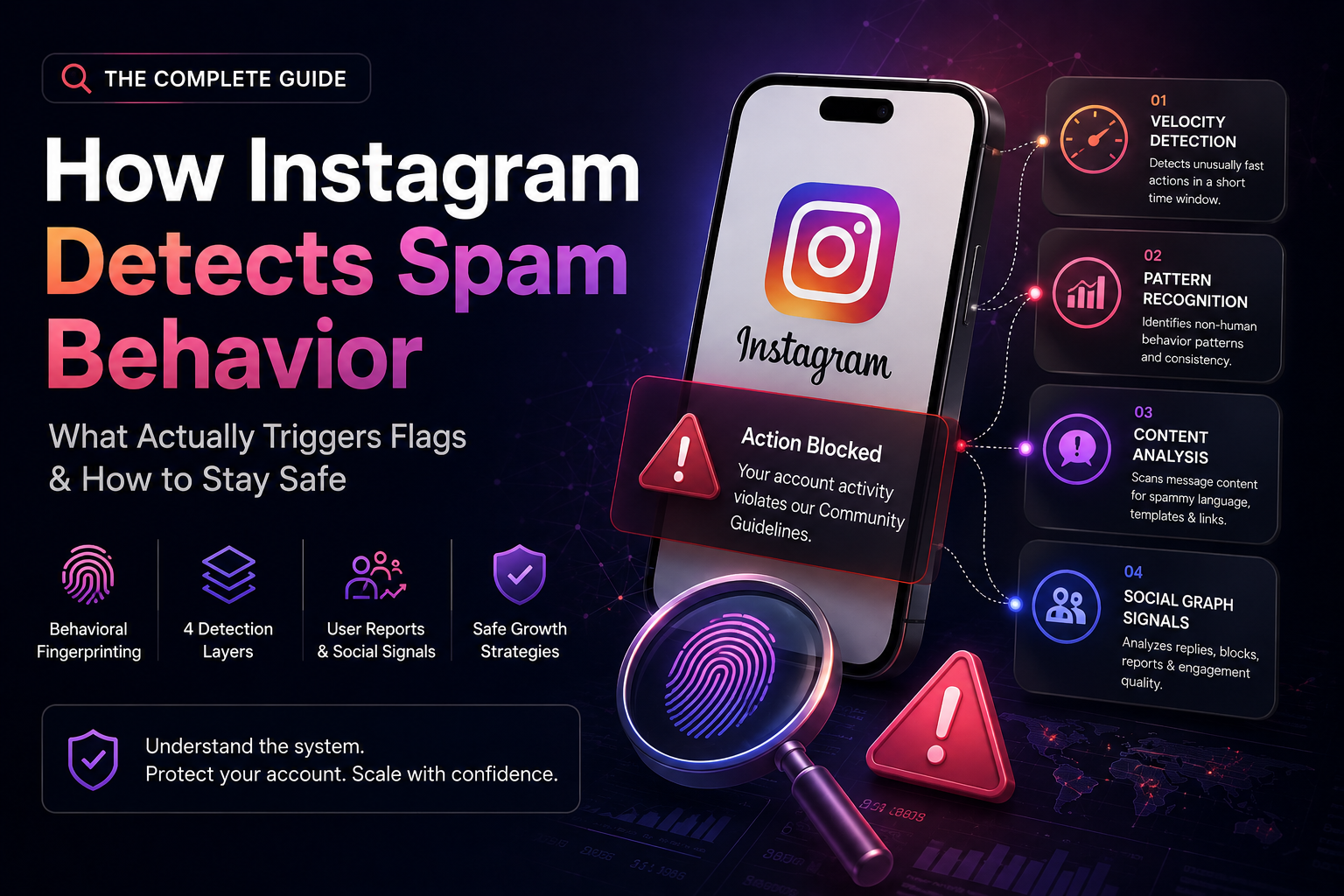
Instagram's spam detection operates across four distinct layers simultaneously.
The first layer is velocity detection. This is the most straightforward how fast are you doing things? Follows, unfollows, likes, comments, DMs, story views. Each action type has an internal velocity threshold. Exceed it in a short enough window and the system flags the behavior. This layer operates in near real time and is the first line of defense against obvious bot activity.
The second layer is pattern recognition. This goes deeper than velocity. The system looks at whether your actions follow human-like patterns across time. Humans are inconsistent they pause, they get distracted, they engage more on some days than others. Bots and automation tools operating outside official channels tend to produce unnaturally consistent patterns perfectly spaced actions, identical time intervals between DMs, engagement activity that doesn't vary across weekends or evenings. The more consistent and mechanical your behavior, the higher your spam probability score.
The third layer is content analysis. Instagram's systems analyze the actual content of your DMs, comments, and captions. Sending the same message body to hundreds of people in a short window is a strong spam signal even if the volume is within normal range. Using certain trigger phrases associated with spam aggressive sales language, link-heavy messages, messages that match known spam templates raises your content risk score independently of your behavioral patterns.
The fourth layer is social graph signals. This is the least understood but arguably the most powerful layer. Instagram looks at how your account interacts with its network whether the people you are DMing or following are engaging back, whether they are blocking or reporting you, whether your outreach is reaching accounts with no mutual connections or suspicious characteristics. A campaign that results in a high rate of ignored messages, blocks, or spam reports from recipients generates strong negative social signals that feed directly into the detection system.
How User Reports Feed the System
When someone marks your DM as spam, ignores a message request, or blocks your account, that action is logged as a negative signal against your account's trust score. A small number of these is normal and expected every account gets some. But when the ratio of negative responses to total outreach spikes, the system takes notice.
This is one of the reasons that message quality matters as much as message volume. A campaign that sends 200 DMs and gets 40 spam reports is far more dangerous to your account than a campaign that sends 500 DMs and gets 3 reports. The content, targeting, and relevance of your outreach directly affects how recipients respond and how the system scores your account as a result.
It is also why blasting cold outreach to completely untargeted lists is one of the highest-risk DM strategies you can run. The lower the relevance of your message to the recipient, the higher the likelihood they ignore, block, or report it and each of those responses chips away at your account's standing with the detection system.
This connects directly to how we built DMRocket's intent based lead tagging targeting people who have already shown interest signals rather than cold audiences dramatically reduces negative response rates. See how it works at dmrocket.co/product/features.
Third-Party Tool Signals
Instagram's detection systems do not just look at what you are doing they look at how your actions are being executed at a technical level.
When a compliant tool built on Meta's official API performs actions on your behalf, those actions carry the correct authentication headers, follow the correct request format, and respect the rate limit responses the API sends back. Instagram's systems recognize this pattern as legitimate third party tool usage.
When a non compliant tool operates outside the API simulating browser sessions, scraping data, or using automation frameworks to click through the interface the technical signature of those actions looks different. Request patterns, timing intervals, session behavior, and authentication methods all leave traces that Instagram's backend systems are trained to identify.
This is why two accounts doing the exact same volume of DMs can have completely different outcomes one using an official API connected tool and one using an unofficial scraper. The behavior looks the same to you. It does not look the same to Instagram's detection layer. We covered the technical side of this in our post on Instagram API limits at dmrocket.co/blog/instagram-api-limits-explained-for-creators.
Machine Learning and the Evolving Detection Model
Instagram's spam detection is not static. Meta invests heavily in updating its machine learning models as spammers and bad actors evolve their tactics.
What this means practically is that behavior that was safe six months ago may not be safe today. Patterns that used to fly under the radar get incorporated into detection models as Instagram trains on new data. This is one of the reasons you see periodic waves of account disables across the creator and brand community Meta pushes a model update and behaviors that were previously tolerated suddenly cross a threshold.
It also means that advice about specific "safe" numbers send no more than X DMs per day, follow no more than Y accounts per hour has a limited shelf life. The numbers matter less than the underlying principle: behave like a genuine human, use compliant tools, and build your account's trust score over time through consistent, high quality behavior.
The brands and creators that survive platform updates are not the ones who found the latest loophole. They are the ones who built their outreach infrastructure on a foundation that aligns with what the platform actually wants real conversations that drive genuine engagement.
What a High Trust Score Actually Looks Like
Instagram's detection systems are not just looking for bad signals they are also building positive trust signals that give your account more headroom.
An account with a high trust score has a long history of consistent, varied activity. It receives genuine engagement on its content. The people it DMs respond positively replying, clicking, converting. Its follower growth is gradual and organic looking. It has no history of content removals, policy violations, or spam reports. It uses tools that connect through official channels with proper authentication.
Building this kind of trust score takes time, but the payoff is significant. High trust accounts can operate at higher volumes with lower risk. They recover faster from algorithmic fluctuations. And when they do hit a rate limit or a detection flag, the system is more likely to treat it as an anomaly rather than a pattern.
The practical implication: every week you spend building genuine engagement on your account before scaling your outreach is an investment in your ability to run larger campaigns safely later. Rushing to scale before your account has earned the trust score to support it is how accounts get disabled weeks into a new campaign.
How This Affects Your DM Outreach Strategy
Understanding the detection system changes how you should think about DM campaigns at every level.
On targeting focus on warm audiences first. People who have commented on your posts, viewed your Stories, clicked your links, or previously messaged you carry strong positive social graph signals. DMing people who already know you exists reduces negative response rates and builds positive engagement signals simultaneously. Cold outreach to completely unknown audiences should come later, after your account has demonstrated a pattern of high quality interactions.
On content vary every message. Even if you are running an automated campaign, each message should have enough variation that it does not read as a template to Instagram's content analysis layer. Personalization tokens, varied openers, and rotating message structures all help. A well-built DM automation platform handles this automatically. See how DMRocket manages message variation at dmrocket.co/product/dmrocket-ai.
On volume ramp up, never spike. If you are increasing your DM volume, do it gradually over two to three weeks rather than jumping from 50 to 500 overnight. The velocity detection layer treats sudden spikes as a strong bot signal regardless of your overall volume.
On timing distribute across the day. Human beings do not send 600 DMs between 9am and 11am. Space your sends across your active hours in a pattern that looks natural. The best DM automation tools handle pacing automatically so you never have to think about this manually.
On tool selection this cannot be overstated. The technical signature of your tool is visible to Instagram's detection systems. Using a tool that accesses your account through unofficial methods puts every campaign you run at risk regardless of how thoughtful your strategy is. If your tool asked for your Instagram password at signup, it is not using the official API. If your tool has never mentioned Meta's Messaging API in any of its documentation, that is worth investigating before your next campaign.
We covered what happened to accounts that ignored this in our post on Instagram account disables at dmrocket.co/blog/instagram-account-disabled-here-s-exactly-what-to-do.
The Compounding Effect of Negative Signals
One thing most creators miss is that spam signals are cumulative and they compound over time.
A single campaign that generates a high spam report rate does not just affect that campaign. It lowers your account's overall trust score in a way that makes every subsequent campaign more likely to trigger a flag even if the subsequent campaigns are perfectly clean. The system has memory.
This is why accounts that have been flagged before are more vulnerable to future disables than accounts with a clean history. They are operating from a lower baseline trust score, which means the detection system needs fewer negative signals to escalate a flag into a restriction.
The reverse is also true. Consistently clean behavior over several months raises your baseline trust score and gives you more buffer before the system takes action. The longer you operate with genuine, high quality outreach, the more resilient your account becomes.
This connects directly to the cross channel memory approach we use at DMRocket when your AI remembers every previous interaction with a contact across Instagram and WhatsApp, the follow-up messages are more relevant, more personal, and less likely to generate negative responses. See how that works at dmrocket.co/use-cases/cross channel-memory.
Final Thoughts
Instagram's spam detection is sophisticated, layered, and constantly evolving. It looks at velocity, behavioral patterns, content, social graph signals, and technical tool signatures simultaneously and it builds a long term trust score for every account on the platform.
The creators and brands that scale DM outreach successfully are not the ones who found the magic number that avoids detection. They are the ones who understood what the system is actually trying to reward genuine human behavior, high quality conversations, and tools that operate within the rules and built their strategy around that.
If you are using Instagram DMs as a revenue channel, the infrastructure underneath your campaigns matters as much as the campaigns themselves. Build it right and the detection system works with you. Build it wrong and every campaign you run is one update away from taking your account down with it.
Start running DM campaigns the right way at dmrocket.co.
Related Articles:
Instagram API Limits Explained for Creators dmrocket.co/blog/instagram-api-limits-explained-for-creators
Instagram Shadowban vs Suspension: What's the Difference? dmrocket.co/blog/instagram-shadowban-vs-suspension-what-s-the-difference
Instagram Account Disabled? Here's Exactly What To Do dmrocket.co/blog/instagram-account-disabled-here-s-exactly-what-to-do
DMRocket helps D2C brands, coaches, and consultants turn Instagram DMs into a real revenue channel using AI automation built on Meta's official API. Start for free at dmrocket.co.
Ready to automate your Instagram DMs?
Join creators and businesses using DMRocket to reply faster, capture hot leads, and turn conversations into revenue.
Get Started Free