Instagram DM Automation: What It Actually Is, How It Works, and Whether It's Worth It
Instagram DMs are a sales channel. Learn how Instagram DM automation works, what's safe, and how to build a system that turns conversations into revenue.

DM Rocket
The inbox problem nobody talks about
You post a reel. It gets 40,000 views. Comments start rolling in — "how much?", "link please", "do you ship to Canada?", "how do I book a session?"
You're excited. This is exactly what you wanted.
Then real life happens. You reply to three DMs, get pulled into a call, and by the time you come back, there are 60 new messages. Half of them asked the same question. A few were genuinely ready to buy. You'll never know which ones, because they've already moved on.
This is the actual problem Instagram DM automation is built to solve.
Not fake growth. Not bot followers. Not spamming strangers with generic pitches.
Real conversations that come in faster than any human can handle — and revenue that gets lost because of slow replies, missed messages, or zero follow-up system.
What Instagram DM automation actually means
Let me be direct here, because the term gets misused constantly.
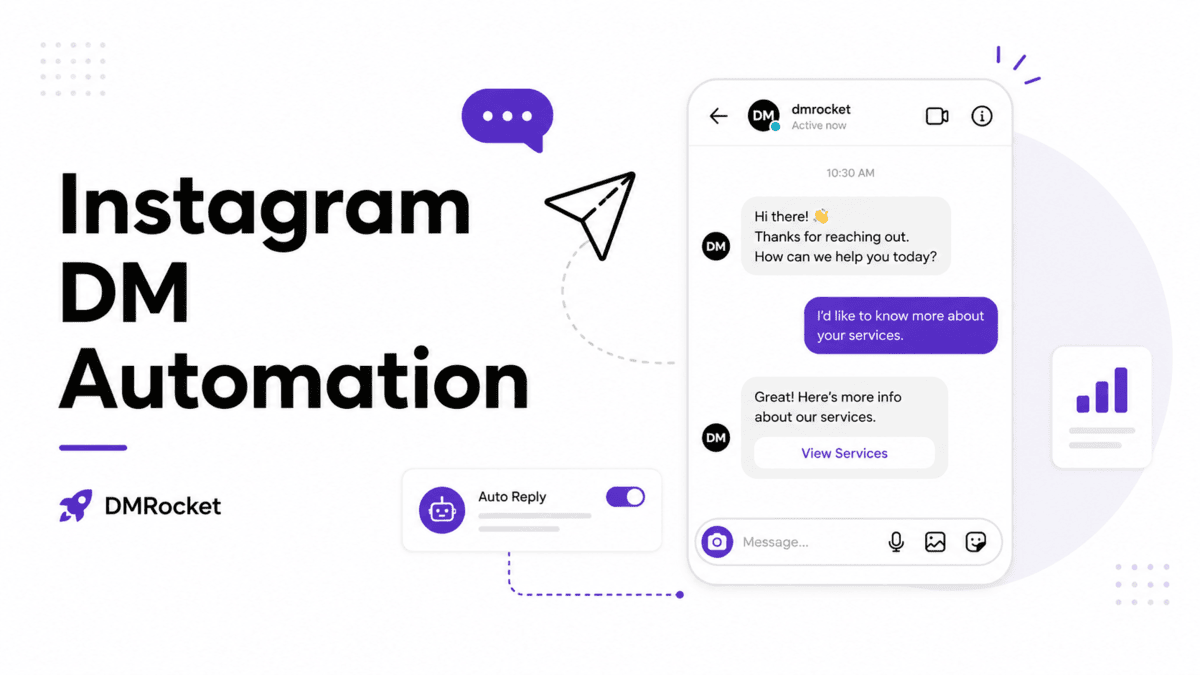
Instagram DM automation is the use of software to automatically respond to, sort, tag, or follow up on direct messages and comments — based on triggers, keywords, and rules you define.
When someone sends you "price?" in a DM, automation sends them the pricing information immediately. When someone comments "interested" on your post, automation sends them a DM with the product link. When a lead says "yes, I want to book" but doesn't actually book, automation follows up.
That's it. It's a response and workflow system for conversations that are already happening.
What it is not: auto-liking, auto-following, scraping DMs from strangers, mass cold outreach, fake comments, or anything designed to trick Instagram's algorithm. That stuff has always been risky, and it has nothing to do with what serious businesses need.
Why Instagram DMs are a sales channel, not a support queue
Most businesses treat their DM inbox like a problem to manage. They're wrong.
Your DM inbox is where buying decisions happen. A person who DMs you "how does this work?" is warmer than anyone who clicked an ad. They came to you. They asked. That's buyer intent sitting right in your inbox.
The numbers don't lie. Response time is one of the biggest variables in whether a conversation converts. Studies across sales and customer service consistently show that responding within the first few minutes dramatically increases the chance of conversion compared to waiting even an hour. On Instagram, where attention moves fast, a delayed reply is often no reply at all.
Beyond response time, there's the volume problem. A creator with a mid-sized following might get 50 to 200 DMs on a good content day. A growing ecommerce brand might have that every single day. No founder, no single VA, no small team can keep up without a system.
Instagram DM automation is how you build that system.
The mechanics: how Instagram DM automation actually works
There are a few core capabilities that make up a proper DM automation setup. Understanding each one helps you decide what your business actually needs.
Keyword triggers
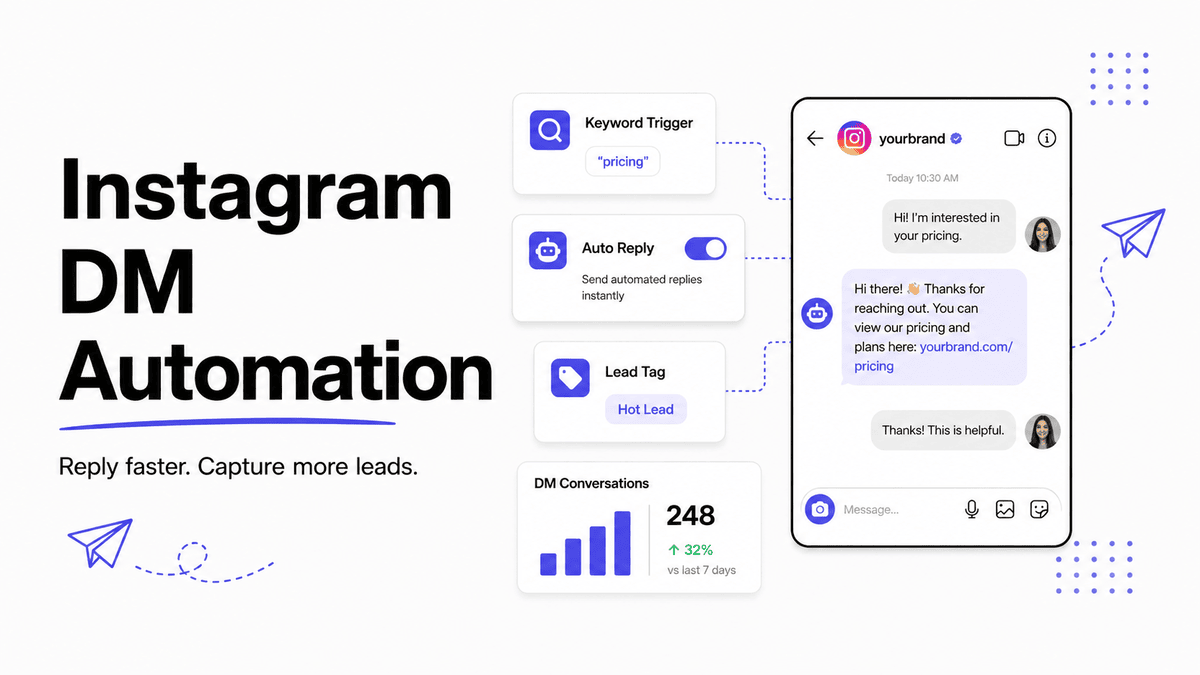
This is the foundation. You define a keyword or phrase — "price", "how do I book", "send me the link", "do you ship", "collab" — and set an automated reply that fires when someone uses that word or phrase in a DM.
The reply can include text, links, questions, or even a full conversation sequence. A coach might set "free call" as a trigger and have the automation instantly share a Calendly link with a short message. An ecommerce store might set "shipping" as a trigger and reply with their shipping policy and a product link.
Done well, this feels responsive and helpful. Done poorly — generic, robotic, and off-context — it feels worse than no reply at all.
Comment-to-DM flows
This is one of the highest-leverage automations for creators and brands. You publish a post or reel and in the caption you say something like "comment GUIDE below and I'll send you the free resource."
When someone comments that word, the automation detects it and sends them a DM with the resource, the link, or the offer.
Why does this work so well? Because it turns passive engagement into a direct conversation. The comment is public. The DM is private and personal. And now you have a lead in your inbox who explicitly raised their hand.
AI-powered replies
This is where things get genuinely interesting. Instead of simple keyword matching, AI replies can understand context, intent, and nuance. A message like "I've been thinking about joining your program but I'm not sure if it's the right fit" isn't a keyword match situation. It's a real conversation that needs a thoughtful response.
AI replies can handle these with relevant, on-brand responses — buying time, providing information, asking qualifying questions, or escalating to a human when needed.
The honest caveat: AI replies need proper setup, training on your brand voice, and ongoing review. Out of the box, most AI won't sound like you. Getting it right takes effort upfront.
Lead capture and tagging
Not every DM is a sale. Some are questions. Some are objections. Some are people who are two weeks away from buying. A proper Instagram DM automation system helps you tag and segment those leads so you can follow up intelligently.
Someone who asked about pricing but didn't buy? Tag them as a warm lead. Someone who asked about wholesale? Tag them separately. Now you have a list you can actually work with.
Follow-up sequences
Someone expressed interest, you sent information, and then nothing. This happens constantly. Automation lets you set a follow-up that fires 24 or 48 hours later — "Hey, did you get a chance to look at what I sent?" — without you having to remember or manually track every open conversation.
This alone recovers a surprising amount of revenue that would otherwise just disappear.
Is Instagram DM automation safe?
This is the question I get most often, and I want to answer it honestly rather than just reassure you.
The short answer: it depends entirely on how it's built and how you use it.
Instagram and Meta have official APIs for business accounts and creators. Automation built on top of these APIs — like what DMRocket is built on — operates within Meta's guidelines. It's not a third-party scraper pretending to be your browser. It's using the channels Meta has officially opened for business communication.
That said, there are real risks you should understand.
Rate limits are real. Even with official API access, Instagram enforces limits on how many messages you can send in a given period. If your automation is firing at scale — especially with cold or unsolicited outreach — you're in dangerous territory. Automation should serve people who are already talking to you, not blast people who didn't ask.
Spam-like behavior gets flagged. If your automated replies feel robotic, irrelevant, or mass-sent, users can report them. Enough reports and Instagram takes action. The goal is helpful automation, not message spam.
Unsolicited DM outreach is high risk. Using automation to cold-DM people who have never interacted with you is a different category of risk entirely. It's not what this is built for, and it's not something I'd recommend for any serious business.
The safe path is simple: automate replies to people who are already reaching out to you. Respond to comments, answer DM questions, follow up on conversations, capture leads who raised their hand. That's where automation adds real value without meaningful risk.
Who actually needs Instagram DM automation
Creators selling something
If you have a course, a coaching program, a digital product, a membership, or even a brand deal process — and you're getting DMs about it — you need automation. The number of sales that slip through because a DM went unanswered for 12 hours is significant.
Ecommerce brands
"Do you ship to X?" "Is this in stock?" "What size should I get?" "Can I return this?" These questions come in constantly and they're largely the same questions over and over. Automation handles the repetitive ones instantly. Your team handles the complex ones. Everyone wins.
Coaches, consultants, and agencies
Lead qualification is where DM automation earns its keep for service businesses. Instead of going back and forth manually, you can automate initial qualification questions, capture relevant information, and route serious leads to your calendar or sales process automatically.
Small businesses and local brands
If Instagram is how people find you and reach out, your DM inbox is your front desk. Automation is how you staff it properly without hiring another person.
Building a real DM sales system on Instagram
The difference between businesses that benefit from Instagram DM automation and those that don't is almost never the automation itself. It's whether they have a system behind it.
Here's what a functional DM sales system looks like in practice.
Start by mapping every common DM you receive. What do people ask most? What triggers a sale? What's a dead end? What needs human involvement? Most businesses have five to ten message types that cover 80 percent of their inbox volume.
Then build your automation around those. A keyword trigger for pricing questions. A comment-to-DM flow on your lead magnet content. An AI reply for general inquiries. A follow-up sequence for people who went cold after showing interest.
Behind all of that, you need visibility. Who messaged, what did they ask, where are they in the conversation, who followed up. That's where an Instagram CRM comes in — not just a chatbot, but a system that organizes your sales pipeline by conversation.
This is the gap DMRocket is built to fill. It's not a simple autoresponder. It's an AI sales CRM designed specifically for Instagram-first businesses — handling DM automation, comment flows, lead capture, buyer intent signals, and conversation management in one place. Built for brands and creators who take their Instagram revenue seriously.
What good automation looks like versus what it doesn't
Good:
A creator posts a reel about their coaching program. In the caption they say "comment READY and I'll send you the details." Someone comments. They instantly get a DM with a short, human-sounding message and a link to book a discovery call. The creator wakes up to five new calls booked.
Also good:
An ecommerce brand sets up keyword replies for "shipping", "size", "return", and "discount". Common questions get instant answers 24/7. The team uses their time for complex conversations and customer issues that actually need judgment.
Not good:
An automation that fires the same generic "Hey! Thanks for reaching out, here's our link 🚀🔥" to every single DM regardless of what the person actually said. Or one that mass-DMs everyone who liked a post with an unsolicited sales pitch.
The line between helpful and annoying is clarity of intent. Automation should make the conversation better for the person on the other end. If it doesn't, you're building something that works against you.
A few honest realities before you start
Instagram DM automation is not a shortcut to revenue. It's a system that makes existing revenue opportunities more reliable and scalable.
If you're getting zero DMs, automation won't fix that. You still need content that drives interest and trust. Automation is for managing the volume that comes from that content, not creating demand from nothing.
If your product or offer is unclear, no automation will save the conversion. People will still be confused; they'll just get confused faster.
And if you set it up and never look at it again, you'll miss the signals that tell you what's working. Your DM data — what people ask, where they drop off, what they respond to — is one of the most underused insights in most businesses. Good automation surfaces that.
The practical takeaway
If you're getting DMs about your product, service, program, or content and you're handling all of them manually — or worse, missing some of them entirely — Instagram DM automation is worth your attention.
Start simple. Map your ten most common DMs. Build keyword replies for the top five. Set up one comment-to-DM flow on your next post. Watch what happens.
Then build from there. Add lead tagging. Add follow-up sequences. Add AI replies for the conversations that need more nuance. Connect it to an Instagram CRM so you have visibility into your pipeline.
The businesses doing this well aren't doing anything exotic. They just stopped letting revenue walk out their inbox unanswered.
Ready to automate your Instagram DMs?
Join creators and businesses using DMRocket to reply faster, capture hot leads, and turn conversations into revenue.
Get Started Free